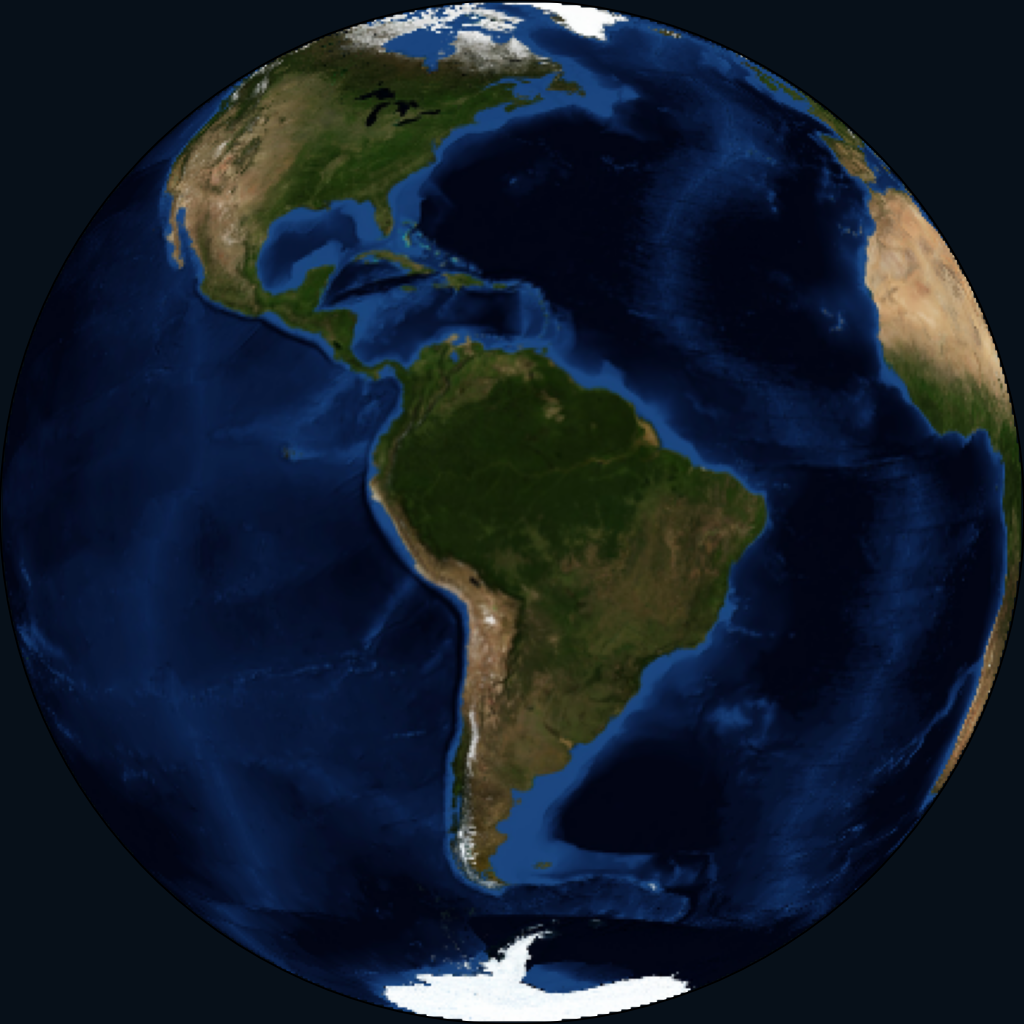
Earth imagery · NASA Blue Marble / BMNG reference
Drag to rotate Earth · wheel to zoom · click a satellite to inspect
A relational decision-research architecture for examining orbital population structure, debris concentration, density, uncertainty and modeled structural load using public catalog-derived evidence.
A correctly oriented real-Earth reference replaces the abstract sphere. ODI propagates the latest cached public GP elements to the current UTC time in the browser, so latitude and longitude can be read against recognizable continents and oceans. The map starts with the public ACTIVE population; debris and rocket-body layers remain a separate next layer.
ODI 2.0 now makes the population effect explicit instead of compressing everything into a generic “high-risk” label.
With the complete public catalog population used by Core 2.0, this broad region ranks first. The present result is strongly shaped by the large active-payload population in lower LEO.
When active payloads are excluded before H/X/V are recomputed, the historical 600–900 km broad region returns to rank #1 in every preregistered sensitivity run.
Each experiment narrowed one question while preserving the frozen Core 2.0 and the evidence record.
Exact v0.2b methodology on the current legacy population preserved LEO 600–900 as the top broad region.
Core 2.0 on the same curated population preserved LEO 600–900, including all 27 sensitivity configurations.
With 28,605 LEO objects, broad ordering changed and LEO 200–600 became #1.
Count effect explained 92.05% of the regional load gap; active payloads were the largest positive additive contributor.
Removing active payloads and recomputing restored LEO 600–900 in 27/27; removing debris preserved LEO 200–600 in 27/27.
Current evidence, reproducibility materials, legacy demonstrators, policy research and institutional documents are presented as separate evidence classes.
Audited public-catalog computation, full-catalog population sensitivity, same-population controls, scale alignment, additive attribution and a preregistered structural population counterfactual through ODIEXP-001F.
It does not claim live telemetry, validated collision probability, operational conjunction warnings, maneuver authority, removal authority, ESA validation, or external certification. OTI and structural load remain research signals.
VEHICLE Systems Lab is a member of NVIDIA Inception. The NVIDIA Inception program is designed to help startups accelerate innovation and growth through developer resources, training, ecosystem access and program benefits.
Claim boundary: this company membership does not imply NVIDIA endorsement, funding, certification, sponsorship, technical validation, adoption, or approval of VEHICLE-ODI.